
Dirt Werks guide. Updated 22 October 2026
How to regrade a gravel driveway so it stays fixed
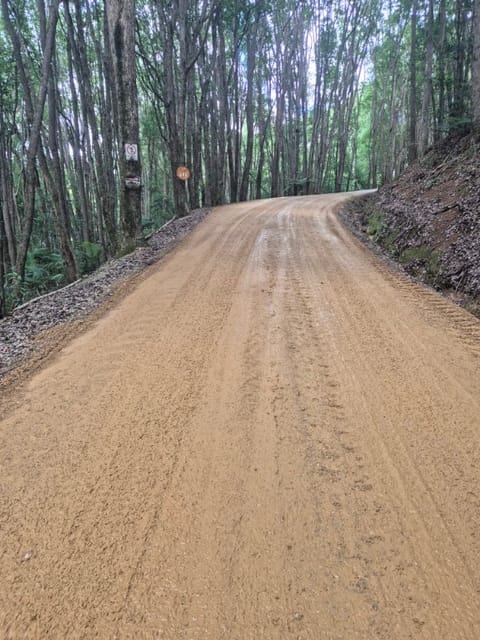
Most gravel driveways fail because water sits on them or runs down them. Luke fixes the shape and the drainage first, then carts in road base on his tipper, spreads it with the posi-track and has it watered and rolled, so rain runs off the sides of the drive instead of down it.
Or send the job details online
- Google 5.0 out of 5 from 2 reviews
- Liability and equipment insurance held
- ABN 58 346 068 875
- Why potholes, corrugations and washouts form
- The steps Luke follows, from prep to the roller
- Crossfall, table drains, culverts and pits
- Crossovers at the road need council approval
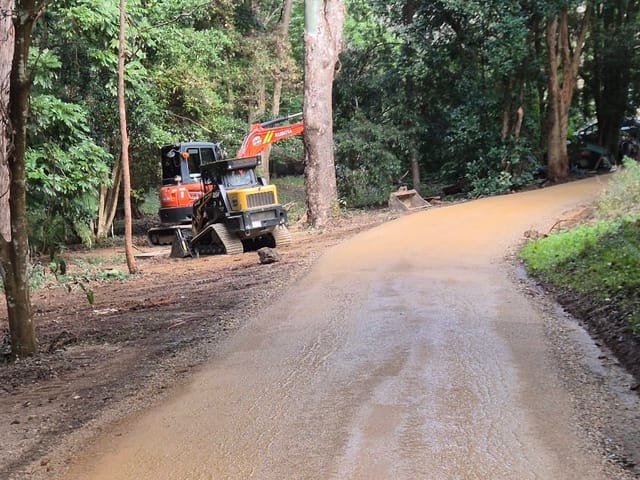
The short answer: fix the water, then the gravel
If your gravel driveway keeps growing potholes, ruts or corrugations, the gravel is rarely the real problem. Water is. It sits in flat spots and softens the base, or runs down the drive and strips out the fines that bind the gravel. More gravel on top only hides the damage until the next big rain.
A lasting fix reshapes the drive to shed water sideways, gives that water somewhere to go, and only then adds material. Regrading reshapes what is already there; a re-sheet is a new layer of road base or gravel on top. Most worn drives need both. Luke works this way on gravel driveway repairs for rural drives, farm roads and bush tracks, and on smaller repairs to gravel house driveways, from his base in Murwillumbah down to Lennox Head.
Signs your driveway needs a regrade or re-sheet
Walk the drive in heavy rain, or just after, and look for:
- Potholes that come back in the same spots, where water sits
- Corrugations, the washboard ripples on hills, corners and braking spots
- Ruts in the wheel tracks that carry water down the drive
- Washouts and scours where running water has cut channels
- Gravel in the table drain, or across the grass at the bottom
- A soft base that turns to mud or sinks under a loaded vehicle
- Grass edges built up higher than the gravel, trapping water on the drive
- Bare dirt or rock where the gravel has worn away
Why potholes, corrugations and washouts form
A gravel driveway needs a shape that sheds water: a crown, higher in the middle and falling to both edges, or a one-way crossfall towards a table drain. Traffic slowly pushes gravel out to the edges until the middle sinks and the drive goes flat or dished. Then water stays on it or runs straight down it.
Road base holds together because of its fines, the dust-sized particles that fill the gaps between the stones. Once running water strips them out, the surface turns to loose stones. That is where corrugations start: wheels bounce, push the loose material into ridges, and every car after that makes them worse. Fast driving, hard braking and steep pinches all add to it.
Ruts and soft spots mean the ground under the gravel has given way. A wet subgrade loses strength, heavy vehicles push it down, and new gravel spread over it just sinks in. That is why soft spots are dug out before any new material goes down.
How Luke regrades and re-sheets a gravel driveway
Photos first
Send photos of the worst sections, the whole run from the road, and where the water goes in rain. Luke quotes from those or a quick site look.
Check for services and power lines
Where drains or culvert trenches will be dug, Luke checks the Before You Dig plans and exposes any buried services by hand before the machine digs close. He keeps at least 3 m clear of overhead power lines.
Prep the surface
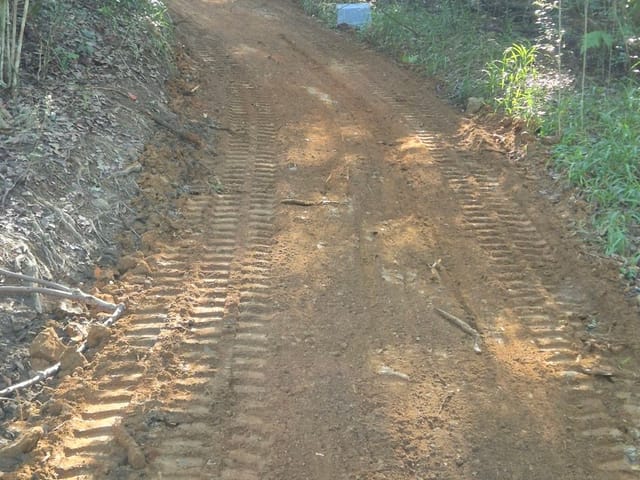
The existing drive is reshaped, and any table drains or culverts go in before new material goes down.
Cart in the road base
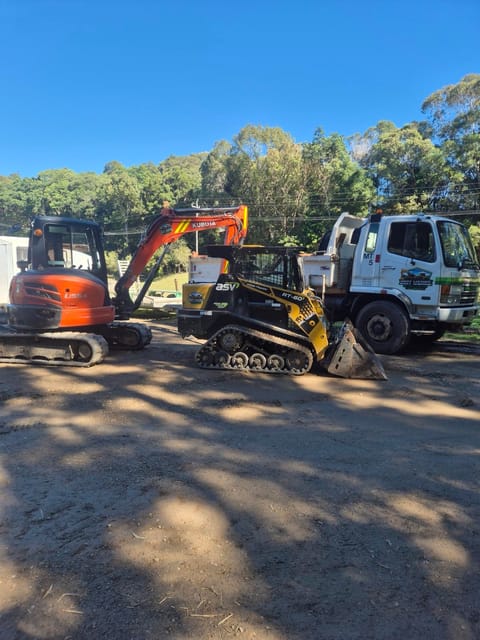
Road base or gravel comes from the quarry on Luke's Fuso Fighter tipper, which carries about 7.5 t a load. It is tipped out through the tailgate, with the truck on level, firm ground and clear of overhead lines.
Spread and shape
The ASV RT-60 posi-track spreads it and shapes the crown or crossfall across the full width of the drive.
Water it
Road base needs moisture to bind, so a water truck is hired in to wet it down.
Roll it
A roller compacts it into a firm, tight surface: the finished drive, or the base a sealing contractor works on.
Sealing comes after the base
Planning to seal with bitumen or asphalt? Shape and drainage matter even more, because a seal laid over a soft or wet base breaks up. Luke prepares the base and a sealing contractor lays the seal afterwards, so tell Luke who yours is and the two jobs can line up.
Road base or gravel: what goes on top
Most re-sheets use road base: crushed rock graded from stones down to fine dust. Watered and rolled, the fines lock the stones into a hard layer that sheds water. Clean gravel with no fines looks tidy but stays loose, so on its own it ruts and spreads. Luke carts road base and gravel from the quarry on his own tipper, so the carting, spreading and shaping are all done by the one operator.
To estimate quantity, multiply the length, the width and the depth of the new layer to get cubic metres. A 100 mm layer on a drive 100 m long and 3 m wide, for example, works out at 30 cubic metres. The quarry can convert cubic metres to tonnes, and at about 7.5 t a load the tonnage tells you roughly how many tipper loads to expect. Luke works it out when he quotes.
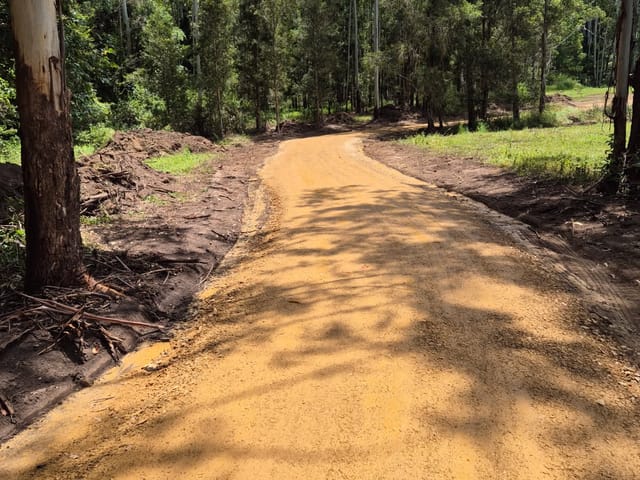
Keeping water off the driveway
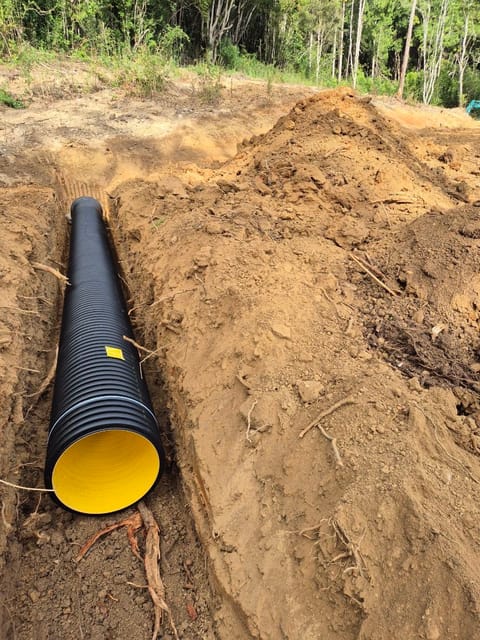
The water shed off the drive needs somewhere to go: a table drain along the edge, a culvert under the drive where a gully crosses it, or a grated pit where water collects. On steep drives, turn the water off at regular points before it builds speed, with a shallow hump or cross drain angled into the table drain.
Luke digs table drains and pipe trenches with the Kubota U55-4 excavator. On rural jobs he lays the culvert or drainage pipe himself and backfills over it. Where stormwater pipe runs to a house or into a council system, Luke digs and backfills the trench, and a licensed plumber lays and connects the pipe. See trenching and drainage.
Two rules to know. Among the NSW conditions for exempt earthworks, the work must not redirect surface or ground water or cause sediment to be carried onto a neighbouring property. And on low coastal ground, deeper drains can disturb acid sulfate soils. Tweed Shire Council says written approval is needed in most cases before they are disturbed. Ballina Shire Council asks anyone digging on or next to the floodplain (below 10 m AHD) to contact Council about its risk maps and whether consent is needed.
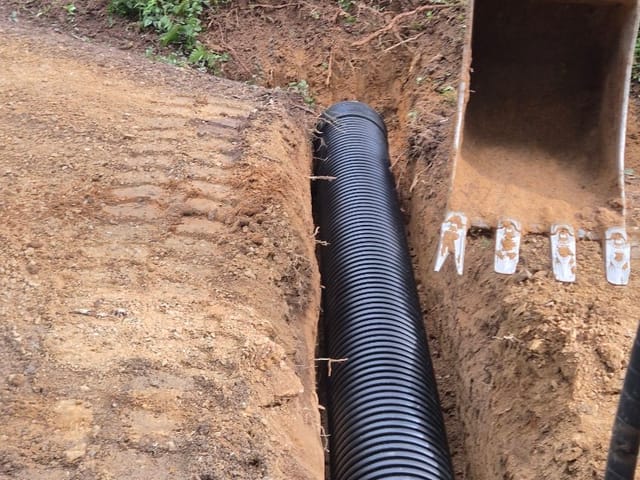
Keep the mud out of the creek
Ballina Shire Council warns that letting soil or sediment pollute waterways is an offence under the Protection of the Environment Operations Act. A stripped driveway is loose ground, so Luke puts up silt fences where runoff from the job could reach drains or creeks.
What you can do between re-sheets
Most of the upkeep comes down to keeping water moving:
- Clear table drains and culvert inlets of leaves, silt and branches before the wetter months.
- Trim the grass edges so they can't build up and trap water on the drive.
- Fix potholes early. Scoop out the mud and water, fill with road base rather than loose stones, and tamp it firm.
- Watch it rain. A short video in a downpour shows where water runs or pools, and it helps Luke quote.
- Slow down. Speed and hard braking build corrugations and throw gravel off the edges.
- Keep heavy trucks off a soaked drive where you can. A wet base gives way under loads it carries easily when dry.
What changes the cost of a driveway regrade
| Factor | Why it matters |
|---|---|
| Length and width | More area means more material, spreading, watering and rolling. |
| State of the base | A sound base may only need reshaping. A soft or washed-out one is dug out and rebuilt first. |
| Material and haul | The tonnes needed, and how far each tipper load of about 7.5 t travels from the quarry. |
| Drainage works | Table drains and culverts add digging, pipe and backfill. |
| Water truck | Hired in to wet the road base before it is rolled. |
| Access and slope | Steep pinches, tight gates, overhanging trees and power lines slow the carting and spreading. |
| Work at the road | A crossover needs council approval first. In Tweed the application includes a work safety plan. |
Crossovers at the road need council approval
The crossover, where your driveway meets the road, sits in the road reserve. Under section 138 of the Roads Act 1993, building, repairing or changing a driveway crossing needs consent from the roads authority, usually the council, and that approval is separate from any DA or CDC. Tweed Shire Council says not to start work until you have it. Its applications need a site plan, longitudinal section, steep slopes plan, work safety plan and the owner's consent, and unapproved works in the road reserve may have to be removed.
Byron Shire Council also requires a permit before driveway works in the road reserve, lodged as a section 138 approval through the NSW Planning Portal, with a DA as well if the driveway isn't exempt development. In both shires, looking after the driveway access is the property owner's job. Rules as at October 2026; your council confirms what applies, and the council approval guide has more.
Luke's gear, driveways and drainage work
Want Luke to look at your driveway?
Text him three photos: the worst section, the whole run from the road, and where the water goes when it rains. That tells him most of what he needs to quote.
Gravel driveway questions
How much does it cost to regrade a gravel driveway?
It depends on the length and width, how much road base goes on, how far it is carted from the quarry, and whether drains or culverts are needed. Reshaping a sound drive is a much smaller job than digging out soft spots and re-sheeting the lot. Luke quotes each drive from photos of the worst sections and the whole run from the road, or from a quick site look if the job needs it.
Should my driveway have a crown or a crossfall?
A crown, high in the middle and falling to both edges, suits drives on flat ground or along a ridge. A one-way crossfall suits a drive cut across a slope: it falls into the hill towards a table drain at the foot of the cut, so water doesn't pour over the downhill edge and eat into the batter. Luke shapes either with the posi-track.
How often does a gravel driveway need regrading?
There is no fixed timetable. A drive with a good crown or crossfall, clear table drains and culverts where gullies cross it holds its shape far longer than one that was only topped up. Steep grades, heavy trucks and big storms shorten the gap. Fixing small potholes early and keeping the drains clear makes the biggest difference.
Do I need council approval to regrade my own driveway?
Any work in the road reserve, including the crossover, needs section 138 approval before it starts. On your own land, Tweed Council says the private part of a driveway may need development approval, though some internal driveways can be exempt development. If the work changes levels or where water leaves your block, check with your council first.
Sources (checked October 2026)
- Tweed Shire Council: Driveways
- Tweed Shire Council: Driveway access to property guide (PDF, October 2021)
- Byron Shire Council: Driveways
- NSW Planning Portal: Section 138 approvals
- NSW Planning Portal: Exempt earthworks, retaining walls and structural supports
- Tweed Shire Council: Acid sulfate soils
- Ballina Shire Council: Acid sulfate soils
- Ballina Shire Council: Erosion and sediment control
- Before You Dig Australia: FAQs
Related
Driveway repairs
Potholes, washouts and worn gravel fixed: regrading, re-sheets and base prep for sealing. Tweed Valley and coast.
See moreSoil removal and tipper
Soil, spoil and rubbish removal to lawful tips, tipper hire with driver, and gravel, road base and soil delivered. Tweed to Ballina.
See moreCouncil approval to excavate
When digging, filling or a retaining wall needs council approval in the Tweed, Byron and Ballina shires, with official sources.
See more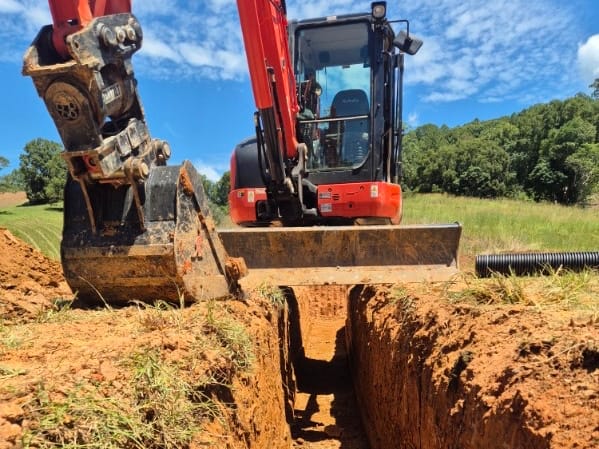
Murwillumbah
Excavator hire and earthworks from Murwillumbah: farm dams, creek crossings, rural driveways, clearing and trenching.
See more