
Dirt Werks guide for the Tweed, Byron and Ballina shires. Updated 22 October 2026
Do you need council approval to excavate in the Tweed, Byron or Ballina shires?
Often, yes. Small cuts, fills and low retaining walls can be exempt, but acid sulfate soils, the road verge, trees and imported fill usually need an approval first. Here is what the Tweed, Byron and Ballina rules say as at October 2026, linked to each official source.
Or send the job details online
- Google 5.0 out of 5 from 2 reviews
- Liability and equipment insurance held
- ABN 58 346 068 875
- Cut, fill and retaining wall limits, Tweed DCP 2025
- Acid sulfate soils, section 138 and tree permits
- Before You Dig, fill, fire ants and runoff
- General information as at October 2026
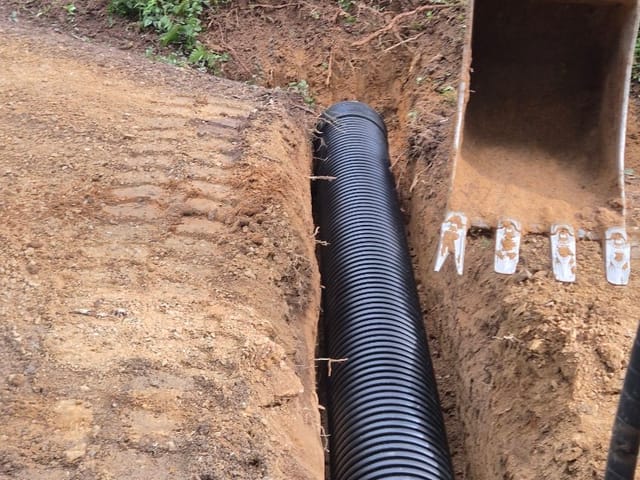
The short answer: when digging needs council approval
The digging itself is rarely the trigger. What matters is where the work is, how deep it goes, what it changes and what arrives or leaves on the truck. The same shallow cut can be simple on a dry hillside and need approval on low coastal ground with acid sulfate soils underneath. Anything that reaches into the road verge needs its own approval anywhere in NSW.
As a rough guide, earthworks and retaining walls up to 600 mm can be exempt development if they meet every state code condition. Bigger work may be complying development, or need a development application (DA). Not sure where yours sits? Ring your council first: Tweed Shire Council on 02 6670 2400, or Byron Shire's Development Support Officers on 02 6626 7025.
General information, not approval advice
This guide summarises council and NSW Government rules as at October 2026. Rules change and every block is different, so your council, certifier or builder confirms what applies to yours. Luke works to the approvals you or your builder hold; he doesn't decide what is exempt.
Which approval for which earthworks job
| Job | What usually applies |
|---|---|
| Cut, fill or retaining wall up to 600 mm | Can be exempt if every state code condition is met |
| Earthworks or retaining walls over 600 mm | May be complying development (CDC) under Schedule 9 of the Codes SEPP; otherwise a DA |
| Earthworks for a new house, shed or other building | Usually assessed with that building's DA or CDC |
| Digging on mapped acid sulfate soil land | Tweed: written Council approval in most cases. Byron and Ballina: consent, by map class and depth |
| Driveway crossover or any work in the road verge | Section 138 approval under the Roads Act 1993, before work starts |
| Bringing in fill or raising ground levels | Development consent in most cases (Tweed and Ballina) |
| Removing trees or native vegetation | Often a council permit in non-rural zones; on RU1 and RU2 rural land, Local Land Services Act approval may be needed |
| Work within 40 m of a riverbank, such as a creek crossing | Possibly a NSW controlled activity approval, and usually council approval too |
| Work on Council water or sewer mains | Tweed: Section 68 approval under the Local Government Act 1993 |
| Moving soil, fill or machines out of a fire ant zone | Restricted under the NSW Biosecurity (Fire Ant) Emergency Order |
General information as at October 2026. Each rule is explained below, with official sources at the end of the page.
Exempt earthworks and retaining walls: the 600 mm line
The NSW Planning Portal's conditions for exempt earthworks and retaining walls include: at least 40 m from a body of natural water; no redirecting surface or ground water; no sediment carried onto a neighbouring property; retaining walls at least 2 m horizontally from any other retaining wall on the site; nothing on a heritage item; and work that is structurally adequate and meets the Building Code of Australia. The Codes SEPP adds limits on cut and fill height and boundary setbacks.
A Tweed Council practice note for the Area E urban release area, around Banora Point and Terranora, reads the state codes as allowing a further 600 mm of cut or fill, and 600 mm retaining walls, without consent. Acid sulfate soil land can still need Council approval. Byron Shire Council notes exempt development can't be used on some environmentally sensitive land, bushfire prone land, national parks or some land containing heritage items.
Tweed DCP 2025 cut and fill limits (from 1 June 2026)
| Control | What DCP 2025 says |
|---|---|
| Cut, slope under 6° (10%) or over 18° (32.5%) | Up to 1 m within the building envelope |
| Cut, slope 6° to 12° (10% to 21.5%) | Up to 2 m within the building envelope |
| Cut, slope 12° to 18° (21.5% to 32.5%) | Up to 3 m within the building envelope |
| Fill, any slope | Up to 1 m within the building envelope |
| Earthworks over 0.6 m above or below existing ground | Held by a retaining wall or other structural support |
| Earthworks over 1 m | Designed and built to a certified structural engineer's specification |
| Outside the building footprint | Cut and fill to 1 m on up to 10% of the site, or 100 m² at most, for usable open space |
| Batters | No steeper than 1:2 unless geotechnical reports satisfy Council |
| Near boundaries (slope height over 0.5 m) | Batters and walls at least 0.9 m (cut) or 1.5 m (fill) from the boundary |
| Retaining walls | No timber walls supporting side boundaries or structures; tiered walls separated by at least the wall height |
| Easements | No cut or fill within them |
| Farm buildings | Not on land sloping over 15%; 1 m of cut and 1 m of fill at most |
From Tweed DCP 2025 Section D1, clauses 2.2.6 (earthworks) and 2.6.4 (farm buildings), as at October 2026. These are the acceptable amounts and some controls allow variations. Your designer works to them, so check with Tweed Shire Council before you plan a sloping block.
Byron and Ballina cut, fill and engineer rules
Byron Shire's DCP 2014 Chapter B14 (Excavation and Fill), in effect since 11 September 2019 and still the current version as at October 2026, applies to earthworks that need development consent. Unless it says otherwise, it limits excavation and filling to 1 m deep. It asks for engineering detail from a structural or geotechnical engineer on land steeper than 15%, or where more than 1 m of cut and fill is proposed.
Ballina's floodplain chapter (DCP 2012 Chapter 2b, the September 2019 version, still current as at October 2026) requires a survey plan showing levels to AHD (Australian Height Datum) with any application for earthworks or filling of land. Where flood-liable lots are filled, retaining walls or dish drains are needed along common boundaries, and fill pads for rural buildings must extend at least 3 m beyond the structure.
Acid sulfate soils in the Tweed, Byron and Ballina
Acid sulfate soils are pyrite-rich marine and estuarine sediments under coastal floodplains. Dig into them, or lower the water table, and air reaches the pyrite, which oxidises to sulfuric acid. Tweed Shire Council says one tonne of iron sulfides can produce about 1.5 tonnes of sulfuric acid, and acid washed into waterways can cause significant fish kills. Byron Shire Council adds corroded concrete and steel, and iron-stained driveways and retaining walls.
Tweed: they are common along the Tweed Coast, and written Council approval is required in most cases before they are disturbed. Council's minor-works plan can't be used where groundwater is likely to be disturbed or dewatering is likely; those jobs need a site-specific plan. Byron: they are generally found below RL 5 m AHD. If you can show the land was lawfully filled and the dig stays within the fill, acid sulfate consent and a management plan aren't needed, though other approvals may still apply. Ballina: contact Council before digging or lowering the water table on or next to the floodplain, below 10 m AHD.
Acid sulfate soil map classes in Byron and Ballina
| Map class | Consent needed for |
|---|---|
| Class 1 | Any works |
| Class 2 | Works below the ground surface, or likely to lower the water table |
| Class 3 | Works more than 1 m below natural ground, or lowering the water table more than 1 m |
| Class 4 | Works more than 2 m below natural ground, or lowering the water table more than 2 m |
| Class 5 | Works within 500 m of Class 1 to 4 land likely to lower the water table below 1 m AHD on that land |
Wording from Ballina LEP 2012 clause 7.1; Byron LEP 2014 clause 6.1 sets the same depths for Classes 1 to 4. Both councils have minor-works plans for some small jobs, so ask which applies. In the Tweed, ask Council for your lot's class.
Driveway crossovers: section 138 approval
Any work on a public road, footpath or verge, including building, repairing or changing a driveway crossing, needs consent under section 138 of the Roads Act 1993, separate from any DA or CDC. The council is usually the roads authority, and Transport for NSW may also need to approve work on some classified roads.
Tweed wants section 138 approval before any driveway work in the road reserve starts. The application needs a site plan, longitudinal section, steep slopes plan, work safety plan and the owner's consent, and Council points to standard drawings S.D.017 and S.D.011 for rural driveways. Unapproved work in the road reserve may have to be removed. In Byron, an exempt driveway still needs section 138 approval, and one that isn't exempt needs a DA as well. Luke regrades gravel driveways; if the job reaches the verge, have the approval first. More in the driveway regrading guide.
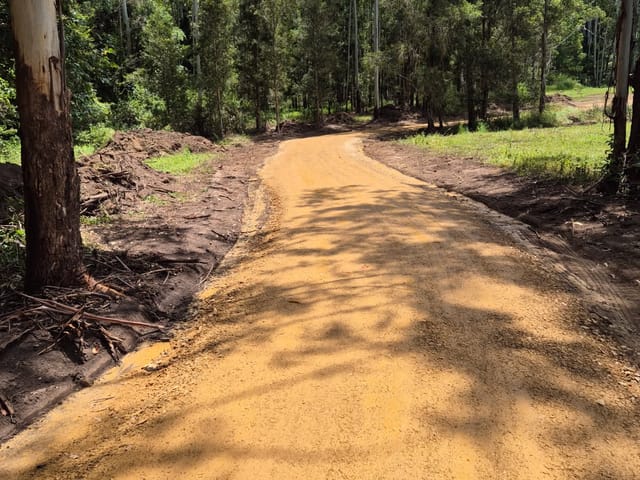
Tree removal and land clearing approvals
The land clearing page has the full table, including Tweed's 5 m rule near houses. In short:
- Tweed, non-rural zones: Council approval to clear declared vegetation, such as native plants 4 m or taller or 10 cm or more in diameter, any tree 40 cm or more in diameter, and koala food trees. Lodging is free.
- Rural RU1 and RU2 land: clearing native vegetation may need approval under the Local Land Services Act 2013.
- Byron and Ballina: Byron uses a Tree Removal Permit. Ballina uses a Private Tree Permit lodged through the NSW Planning Portal, and no work starts until it is issued.
Filling land, spoil, fire ants and runoff
- Filling land. Tweed and Ballina councils say filling land needs development consent in most cases. Tweed revised its flood planning levels in March 2026 (DCP Section A3), so check with Council's Flooding and Stormwater Engineer on 02 6670 2400 before you design. In Byron, a DA to fill land in the flood planning area must address DCP Chapter C2 (Areas Affected by Flood), in effect since 6 June 2025.
- Spoil. Soil from a site where the acid sulfate soil risk maps show any probability of acid sulfate soils can't be classed as virgin excavated natural material (VENM) unless it is tested under the Acid Sulfate Soils Assessment Guidelines and no reduced inorganic sulfur is detected. Luke takes spoil only to lawful tips or approved sites, with dockets, on his tipper.
- Fire ants. As at Emergency Order (No. 10) 2026, published 1 September 2026, the Murwillumbah and Wardell (Ballina Shire) movement control areas remained in place, and NSW land within 5 km of detections in Queensland and Tweed Heads South is in the fire ant infested area. Moving soil, fill, mulch, quarry materials or earth-moving equipment out of those areas is restricted, so check the DPIRD fire ant zone map first.
- Runoff. Ballina Shire Council warns that letting soil or sediment into waterways is an offence, with penalties that can exceed $8,000. Luke puts silt fences in where runoff could reach a drain or creek.
Before You Dig, power lines and trenches
- Before You Dig Australia. Lodging an enquiry is free, and asset owners are encouraged to respond within 2 business days, so lodge a few days ahead. Plans have an expiry date. Luke checks them and potholes by hand before the machine digs near services.
- Power lines. SafeWork NSW's Code of Practice for work near overhead and underground electric lines started on 22 May 2026, replacing the 2006 code. A SafeWork NSW safety alert says that where the risk can't be eliminated, mobile plant keeps at least 3 m from lines up to 132,000 volts, 6 m up to 330,000 volts and 8 m above that. Luke works to those distances. Essential Energy, the Tweed's network operator, is on 13 23 91.
- Trenches. A trench deeper than 1.5 m needs a safe work method statement (SWMS), with its sides made safe by benching, battering, shoring or a geotechnical engineer's written advice. Luke barricades open holes, and nobody is in the hole while the machine digs. He digs and backfills service trenches; a licensed plumber or electrician lays and connects.
Got your approvals? Send Luke the details
Call or text Luke on 0488 987 325 with a few photos and any approved plans for driveway, trenching, clearing or soil removal work, or use the quote form.
Council approval questions
Can I build a retaining wall without council approval?
Sometimes. Under the NSW exempt standards a wall must be at least 2 m horizontally from any other retaining wall on the site and 40 m from natural water, must not redirect water or push sediment onto a neighbour, and must be structurally adequate. Tweed's Area E practice note reads the codes as allowing walls up to 600 mm without consent. Above that, expect a CDC or DA.
Do I need council approval to dig a trench on my property?
It depends where it runs. On mapped acid sulfate soil land, Byron and Ballina need consent for any works on Class 1 land and works below the surface on Class 2, and Tweed needs written approval in most cases. Anything in the road verge needs section 138 approval. Either way, get current Before You Dig plans first.
Do I need approval to fill a low spot on my block?
Usually. Tweed and Ballina councils both say filling land needs development consent in most cases, and flood-prone land adds flood level rules. Ask where any fill comes from, and if you're in or near a fire ant zone, check the DPIRD rules before it moves.
How do I find out if my block has acid sulfate soils?
Ask your council for your lot's acid sulfate soil map class. Tweed Council says the soils are common along the Tweed Coast and asks you to ring 02 6670 2400 before starting. Byron says they are generally below RL 5 m AHD in coastal floodplains, and Ballina asks anyone digging on or next to the floodplain below 10 m AHD to contact Council.
Who applies for the approvals, me or the contractor?
The landowner, or someone applying with the owner's consent, such as the builder on a building job. Tweed's section 138 driveway application, for example, needs the owner's consent. Luke doesn't decide what is exempt. Send any approval and its plans with your photos when you ask for a quote, so the job is priced to its conditions.
Sources (as at October 2026)
- Tweed Shire Council: Development Control Plan 2025, effective 1 June 2026
- Tweed Development Control Plan 2025 (PDF): D1 2.2.6 earthworks, D1 2.6.4 farm buildings, B6 soil management
- Tweed Shire Council: Area E cut and fill practice note (DCP Section B24)
- Tweed Shire Council: acid sulfate soils
- Tweed Shire Council: land constraints
- Tweed Shire Council: driveways
- Tweed Shire Council: trees on private land
- Tweed Shire Council: disposal of fill
- Tweed Shire Council: flood risk management
- Tweed DCP Section A3 Development of Flood Liable Land, version 1.7, March 2026 (PDF)
- Tweed Shire Council: works on Council water and wastewater infrastructure
- Tweed Shire Council: electricity network
- Tweed Shire Council: fire ants
- Byron Shire Council: driveways
- Byron Shire Council: exempt and complying development
- Byron Shire Council: Development Control Plan 2014 chapters
- Byron Shire DCP 2014 Chapter B14 Excavation and Fill (PDF)
- Byron Shire Council: acid sulfate soil management plan for minor projects (PDF)
- Byron Shire Council: trees
- Ballina Shire Council: acid sulfate soils
- Ballina Shire Council: acid sulfate soil management plan for minor works (PDF)
- Ballina Shire DCP 2012 Chapter 2b Floodplain Management (PDF)
- Ballina Shire Council: available fill material
- Ballina Shire Council: Private Tree Permit guide (PDF)
- Ballina Shire Council: erosion and sediment control
- NSW Planning Portal: exempt earthworks, retaining walls and structural supports
- NSW Planning Portal: complying development for earthworks and structural supports
- NSW Planning Portal: section 138 approvals
- NSW Water: controlled activity approvals on waterfront land
- NSW EPA: virgin excavated natural material (VENM)
- NSW Government: fire ants confirmed and treated at a Tweed Heads site, July 2025
- NSW Department of Primary Industries and Regional Development: fire ants
- NSW DPIRD: map of fire ant infested areas and zones
- NSW DPIRD: Fire Ant Emergency Order (No. 10) 2026 plain English guide, 1 September 2026 (PDF)
- Before You Dig Australia: FAQs
- SafeWork NSW: Work near overhead and underground electric lines Code of Practice, May 2026 (PDF)
- SafeWork NSW: mobile plant operating near overhead power lines
- SafeWork NSW: excavation collapse
Related
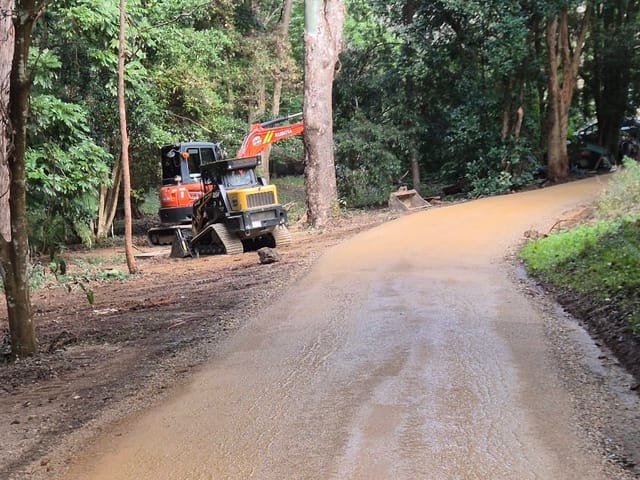
Driveway repairs
Potholes, washouts and worn gravel fixed: regrading, re-sheets and base prep for sealing. Tweed Valley and coast.
See more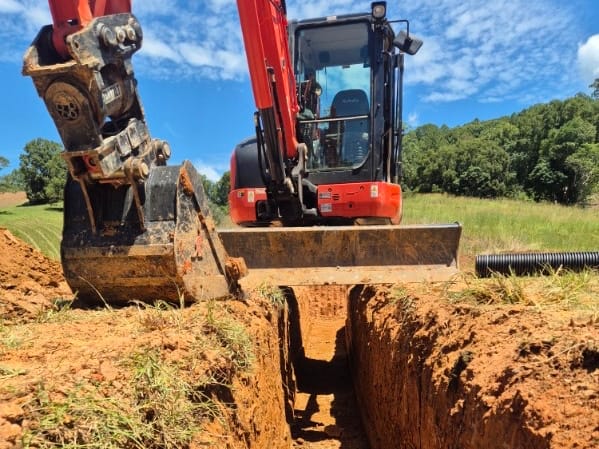
Trenching and drainage
Trenching for plumbing, power and drainage, Gold Coast to Lennox Head. Before You Dig checked, dug to grade, backfilled.
See more
Soil removal and tipper
Soil, spoil and rubbish removal to lawful tips, tipper hire with driver, and gravel, road base and soil delivered. Tweed to Ballina.
See more
Land clearing
Land clearing, stump removal, farm dams, creek crossings and access tracks across the Tweed and Northern Rivers.
See more